

If you’re researching custom home builders across the Surf Coast and Geelong, you’ll find no shortage of beautiful images; polished kitchens, designer bathrooms, and impressive coastal facades.
What you won’t usually find is the process behind those results. And that’s where the real difference lies.
A home that delivers on aesthetics and performance isn’t simply the result of quality materials or good intentions. It comes from a structured building process that reduces unknowns early, coordinates decisions clearly, and is refined with every project.
When people start the search for a builder, they’re usually trying to navigate the common fears:
- Not fully understanding the process.
- Rushed decisions they regret later.
- Budget blowouts that appear halfway through the build.
- Delays that stretch the project well beyond it’s scheduled finish.
Most homeowners build only once or twice in their lives. The goal should be more than just a beautiful home; it should be a building journey that feels clear, well-supported, and professionally guided.
This article explores how a better building process protects your budget, timeline, and long-term comfort — and why it’s the hidden foundation of every successful custom home on the Surf Coast.
Why Process Matters More In A Coastal Climate
Building in Torquay or Barwon Heads isn’t the same as building inland.
The coastal environment introduces additional variables. Strong winds, salt exposure and consistent moisture considerations all influence how a home should be designed and built.
Material choices matter more. Construction detailing matters more. Sequencing between trades matters more.
When these elements are properly coordinated, the result is a home that delivers lasting comfort, durability, and efficiency for decades. When they’re not, the consequences often don’t appear until years later; in the form of higher energy bills, maintenance issues, and reduced comfort.
This is why experienced coastal builders place so much emphasis on planning and coordination during the early stages of the project.
What A Better Process Protects For Homeowners
A refined building process is not administration for its own sake. It protects the things homeowners care about most.
When decisions are made early and documentation is detailed, budgets become more reliable and costly variations are far less likely. Clear documentation and coordinated planning also reduce common causes of delay, such as late selections or trades working from incomplete information.
Quality is protected as well. Critical construction details like airtightness, insulation continuity and moisture control must be inspected before they are covered. A structured process ensures these checks happen at the right time.
The end product is a home designed to perform properly in Surf Coast conditions, with careful consideration given to orientation, glazing, ventilation and thermal detailing. Just as importantly, it creates a calmer building experience. Clear milestones, structured communication and guided decision-making reduce guesswork and prevent decision fatigue.
In Torquay or searching for a luxury home builder along the Surf Coast, this is what a well-run project really looks like. Not just a beautiful result, but a building experience that is organised, transparent and professionally managed.
The Process Behind A Better Outcome
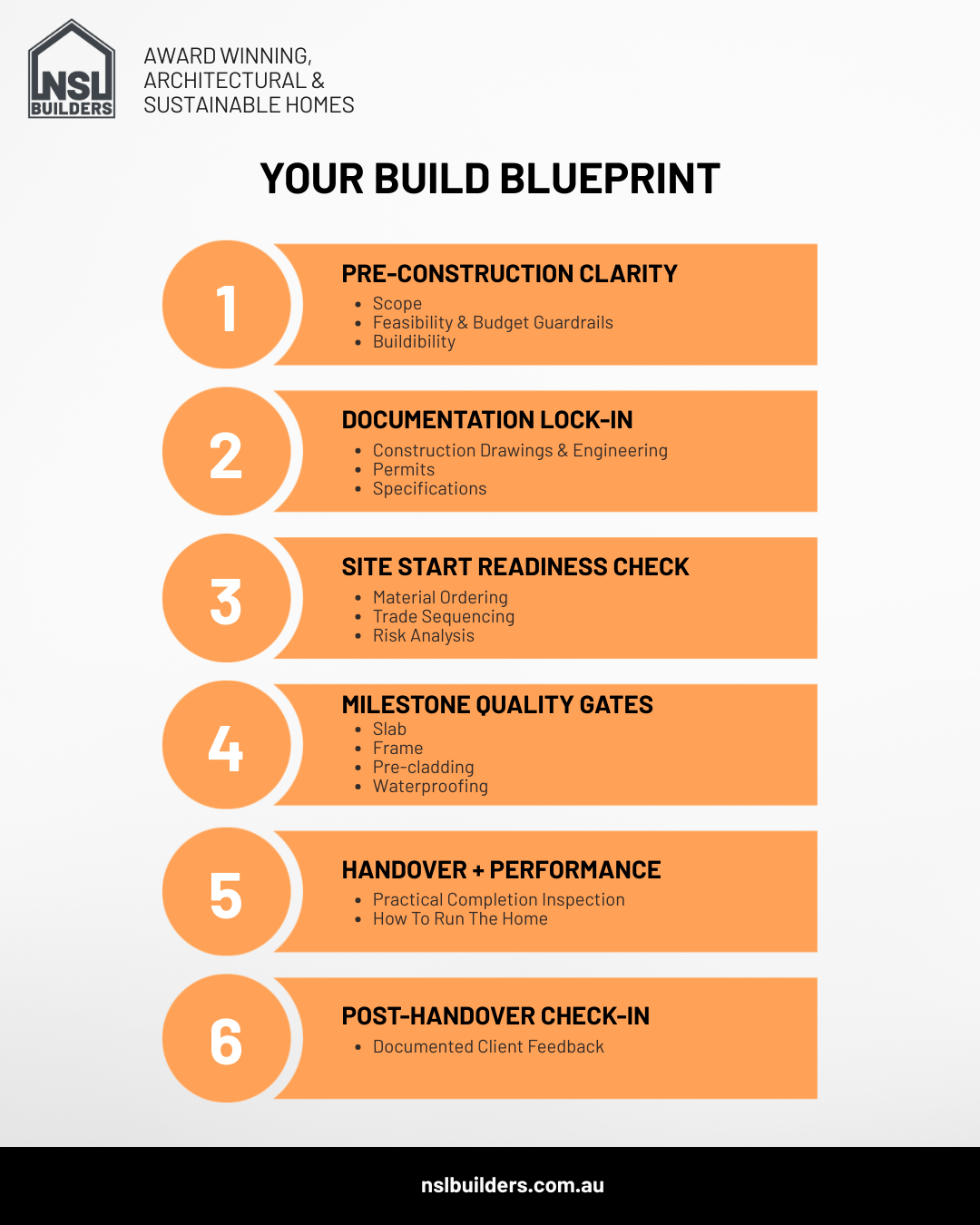
A well structured building process follows clear, deliberate stages: from early design and planning through to construction and post-build review. Each stage supports the next, creating alignment between the builder, trades and homeowner to deliver the home as it was intended.
A Collaborative PreConstruction Phase: WhereThe Best Outcomes Are Created
The Pre Construction phase is where the most important decisions in a custom home project are made. It’s also the phase where decisions can still be refined easily without costly consequences.
When the client, designer, and builder collaborate from day one, the project benefits from a shared understanding of the vision, budget, and practical realities of construction. Early collaboration allows ideas to be refined together so design intent, buildability, performance, and cost are aligned from the start.
This stage typically includes design coordination, engineering input, energy performance alignment, interior selections guidance, and early budget validation.
At this point, adjustments are straightforward. Moving a window on paper is simple. Moving it during construction can affect structural engineering, material orders, weatherproofing details, construction sequencing, and the project budget.
A thorough Pre Construction phase helps protect fixed pricing, minimise variations during the build, and ultimately creates a smoother building journey for everyone involved.
Documentation That Aligns the Whole Team
As part of the Pre Construction phase, all key project documentation is carefully coordinated and finalised. It’s critical that this information is complete, accurate, and aligned before the project is handed over to the construction team.
Designers, engineers, energy assessors, building surveyors, the builder, and trades all rely on the same set of information to coordinate their work.
Clear documentation defines more than just the layout of the home. It establishes performance expectations and construction standards. Construction drawings provide the shared reference point for everyone involved in the build. Specifications include detailed information about the materials and systems to be used throughout the build; including framing & structural requirements, insulation, window & door selection, waterproofing methods, and the fixtures, fittings, & finishes that define the final home.
When documentation is clear and complete, trades can work confidently and efficiently, helping the entire project run more smoothly.
Structured Coordination During Construction
Even with detailed documentation, construction always requires ongoing coordination.
Regular internal reviews, milestone inspections and forward planning meetings help keep the build aligned with the original design intent.
Critical construction details must be inspected before they are covered. This includes confirming insulation continuity before plaster, sealing service penetrations and reviewing weatherproofing layers before external cladding is installed.
These checkpoints help identify small issues early, when they are still simple to resolve.
Systems That Support Consistency
Quality outcomes rely on consistent systems.
Clear processes and standard operating procedures help ensure inspections occur at the right stages, critical construction details are not overlooked, and trade sequencing is carefully managed to support long term reliability.
This includes structured quality checks during construction, clear communication between trades, and defined workflows that keep projects progressing in the right order.
Consistency is supported through regular team communication. Daily check-ins on site, structured weekly team meetings, and detail focused internal reviews help ensure any issues are identified early, resolved quickly and used to refine the process for next time.
Once a project is complete, a structured post-build review allows the team to reflect on what worked well, identify opportunities for improvement, and continually refine the systems that support future builds.
These learnings can then be fed back into the process, allowing systems to be continually refined and standard operating procedures strengthened.
The result is greater consistency across projects, fewer defects or rework, and a smoother building experience for both the construction team and the homeowner.
Continuous Learning
Residential construction continues to evolve as building science, materials and regulations improve.
Many modern high performance homes draw on principles used in Passive House methodology, such as improved airtightness, insulation continuity and energy efficiency. These ideas are applied in ways that suit the Surf Coast climate and typical Australian construction methods.
Applying these principles carefully can improve comfort while helping reduce long-term energy use.
Real-Life Scenarios: Why Process Protects You
The “Small Change” Scenario
A late decision to widen a window affects more than just the opening. Framing layouts change. Engineering may need to be recalculated. Window orders shift. Flashing details and weatherproofing layers must be reconsidered.
Decided early: A simple adjustment on paper.
Decided late: Additional cost, delays, and coordination across multiple trades.
The “Late Selection” Scenario
Joinery selections made after the rough-in stage can trigger a cascade of changes. Electrical points move. Plumbing locations shift.
Selections made early: A structured pre-construction process with clear decision milestones keeps the project organised and predictable.
Selections made late: Site work slows, timelines stretch, and variations may become unavoidable.
The “Hidden Moisture Risk” Scenario
Moisture control layers missed before plasterboard. WRB membranes not properly sealed. Small insulation gaps that later allow condensation to form.
With systems in place:
Stage specific quality control checklists ensure these details are inspected before the home is closed up, allowing any issues to be identified and rectified early.
Without systems in place:
Moisture risks can remain hidden within the building fabric, sometimes only becoming apparent years after handover.
What To Ask Your Potential Builder
Whether you’re looking to for a quality renovation, planning a knockdown rebuild, or searching for design and build partner ask:
- What happens in Pre Construction before the site start?
- How are drawings, engineering and energy requirements coordinated?
- What are your weekly and monthly quality checks?
- How are variations managed?
- How is client feedback documented and implemented?
If a builder can answer these questions clearly, their outcomes are likely structured and well managed rather than reactive.
Process Is The Real Luxury
Building a custom home is a significant investment. Most homeowners are doing it once or twice in their lifetime, and they want the experience to be well organised, transparent and professionally managed.
Today, luxury means more than premium finishes or architectural design. It means:
- Defined budgets that stay under control.
- Realistic timelines that are carefully managed.
- Homes that stay warm in winter and comfortable through summer.
- Materials and construction that stand up to coastal conditions.
- Lower running costs over the life of the home.
Most importantly, it means working with a builder who plans ahead and guides the process with care. Those outcomes do not happen by chance. They come from a disciplined and continually refined building process.
The Standard Is Rising
As more discerning homeowners build across Geelong and the Surf Coast, expectations are evolving.
Many are no longer looking for a builder alone. They are looking for a design and build partner, a team that understands sustainable construction, and a builder who approaches each project with a high-performance mindset.
They also expect a team that learns from every project and continues refining how homes are planned and built.
Meeting those expectations requires structured systems, consistently working behind the scenes.
Closing Thought
Better homes don’t come from rushing.
They come from:
- Clear documentation
- Coordinated decision making
- Structured communication
- Continuous improvement
- Systems that protect performance
If you’re looking for a custom home builder in Torquay or planning a project anywhere across the Surf Coast, Geelong or the Bellarine – look beyond the finished photos.
Ask about the process.
Because in the end, the homes that feel calm, comfortable and durable for decades are not built by chance.
About NSL Builders
NSL Builders is an award-winning, sustainable home builder serving the Surf Coast, Geelong and Bellarine Peninsula. As a registered BPC Builder (CDB-U 70584), Master Builders Association member and Certified Passive House Tradesperson, we specialise in custom homes, knockdown rebuilds, and design & build projects that prioritise comfort, efficiency, and longevity. Contact us to discuss your next project today.